2026-08-13 | Updated 2026-08-26 | Product Guide
Oxalic Acid (CAS 144-62-7) — Complete Buyer Guide
Applications, specifications, packaging, and bulk supply from China
What is Oxalic Acid?
Oxalic acid (H₂C₂O₄·2H₂O) is the simplest dicarboxylic acid. It appears as a white crystalline powder, highly soluble in water, with a mild acidic odor. With CAS number 144-62-7 and molecular weight 90.03 g/mol, it is one of the most widely used organic acids in industrial chemistry.
Unlike many industrial chemicals, oxalic acid is classified as a non-hazardous material — it does not require a UN number for shipping, making logistics simpler and more cost-effective.
Key Industrial Applications
1. Metal Cleaning & Rust Removal
Oxalic acid is an excellent rust remover and metal cleaner. It dissolves iron oxide (rust) without attacking the base metal, making it ideal for:
- Removing rust from steel surfaces, tools, and machinery
- Cleaning metal parts before painting or coating
- Pickling baths for stainless steel and other alloys
- Descaling boilers and heat exchangers
Compared to hydrochloric acid, oxalic acid is less aggressive and safer to handle, reducing workplace hazards and environmental impact.
2. Leather Tanning & Processing
In the leather industry, oxalic acid serves as a:
- Pre-tanning agent to condition hides
- Bleaching agent for light-colored leather
- pH adjuster in dyeing processes
- Acid for chrome-free tanning formulations
3. Rare Earth Extraction
Oxalic acid is a critical reagent in rare earth processing. It is used to precipitate rare earth oxalates from solutions, an essential step in the production of:
- Neodymium and praseodymium (used in permanent magnets)
- Cerium compounds (catalysts, glass polishing)
- Lanthanum (batteries, optical glass)
As global demand for rare earth elements grows — driven by EV motors and wind turbines — the demand for high-purity oxalic acid in this sector continues to rise.
4. Textile & Dyeing Industry
Oxalic acid is used as a bleaching agent and dye-fixing agent in textile processing. It helps:
- Remove rust stains from fabric
- Whiten cotton and wool fibers
- Fix dyes on protein-based fabrics
5. Pharmaceutical & Chemical Synthesis
Oxalic acid serves as an intermediate and reagent in pharmaceutical manufacturing, including synthesis of certain antibiotics and as a reducing agent in chemical reactions. It is also used in laboratory analysis and as a primary standard in volumetric analysis.
6. Wood Bleaching & Stone Cleaning
In woodworking, oxalic acid effectively removes iron stains, water marks, and tannin discoloration from wood surfaces. In stone restoration, it removes rust stains from marble, granite, and other natural stones without damaging the surface.
Technical Specifications
| CAS Number | 144-62-7 |
| Molecular Formula | H₂C₂O₄·2H₂O |
| Molecular Weight | 126.07 g/mol (anhydrous: 90.03) |
| Appearance | White crystalline powder |
| Purity | ≥99.5% (industrial), ≥99.9% (pharma grade) |
| Boiling Point | 157°C (sublimes) |
| Flash Point | N/A (non-flammable) |
| Density | 1.90 g/cm³ |
| Solubility in Water | 143 g/L (20°C) |
| UN Number | N/A (non-hazardous) |
Packaging & Shipping
Oxalic acid is available in the following packaging options:
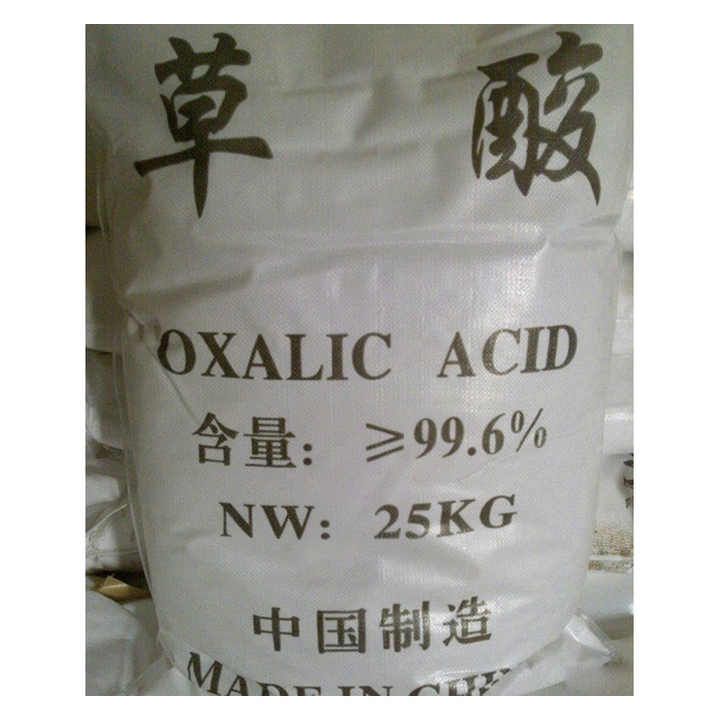
- 25kg PP woven bags — standard industrial packaging, palletized for container shipping
- 500kg jumbo bags — for large-volume buyers, easy to handle with forklifts
- 1000kg jumbo bags — maximum efficiency for bulk orders
Since oxalic acid is non-hazardous, it ships as general cargo — no special documentation or handling required. This reduces freight costs and simplifies customs clearance.
Available FOB: Qingdao, Shanghai, Ningbo, Dalian, Tianjin, Zhangjiagang.
Why Source Oxalic Acid from China?
China is the world's largest producer and exporter of oxalic acid, with major manufacturing hubs across the country. Key advantages of sourcing from China include:
- Competitive pricing — China's large-scale production keeps unit costs low
- Reliable supply — Multiple manufacturers ensure stable availability
- Quality consistency — Major producers meet international standards (ISO, REACH)
- Flexible logistics — Multiple port options for efficient global shipping
Why Choose VASTEC Chemical?
- ✅ Factory-direct pricing — no middlemen, competitive rates
- ✅ Quality inspection — SGS/Bureau Veritas inspection available
- ✅ Flexible payment — LC, TT, CAD
- ✅ Fast delivery — 2-3 weeks lead time
- ✅ 54 industrial chemicals in stock — one-stop sourcing
- ✅ Global export experience — 30+ countries served
Frequently Asked Questions
Is oxalic acid the same as ethanol acid?
No. Ethanol acid (glycolic acid) is a different compound. Oxalic acid is HOOC-COOH (a dicarboxylic acid), while glycolic acid is HOCH₂COOH (an alpha-hydroxy acid). They have different applications and properties.
Can oxalic acid be used in food processing?
Food-grade oxalic acid exists but is subject to strict regulations. The industrial-grade oxalic acid supplied by VASTEC is intended for industrial applications only — metal cleaning, leather processing, chemical synthesis, etc.
How should oxalic acid be stored?
Store in a cool, dry, well-ventilated area. Keep containers tightly sealed to prevent moisture absorption. Oxalic acid is hygroscopic and can form a hydrate if exposed to humidity. Shelf life is typically 12-24 months from date of manufacture.
What is the minimum order quantity?
Contact VASTEC for current MOQ and pricing. We accommodate both trial orders and full container loads.
Need Oxalic Acid?
Contact VASTEC Chemical for competitive pricing, samples, and technical support.
Get a Quote → WhatsApp Us