2026-10-05 | Product Application Guide
Caustic Soda (NaOH, CAS 1310-73-2) — Industrial Applications & Buyer's Guide
Caustic soda — also known by its CAS 1310-73-2 — is one of the most heavily used inorganic chemicals in the world. It is the workhorse alkali behind alumina refining, pulp and paper production, soap manufacturing, textile processing, and water treatment, and it is a key feedstock for a long list of downstream chemicals. This guide explains the forms caustic soda is shipped in, the applications that drive global demand, the grade specifications buyers should verify, and the safe-handling practices every importer should know.
Forms and Grades of Caustic Soda
Caustic soda is produced by electrolysis of brine (the chlor-alkali process). Three commercial forms dominate global trade:
- Liquid caustic soda (50% NaOH, also called caustic lye) — the lowest-cost form for high-volume users with on-site storage tanks and ISO tank receiving capability. Most major chemical complexes use 50% liquid because it avoids the cost of dissolving solid forms on site
- Caustic soda flakes — thin solid flakes produced by drum-flaking molten NaOH. Flakes dissolve quickly and are easier to ship to destinations without liquid receiving infrastructure. This is the most common export form from China
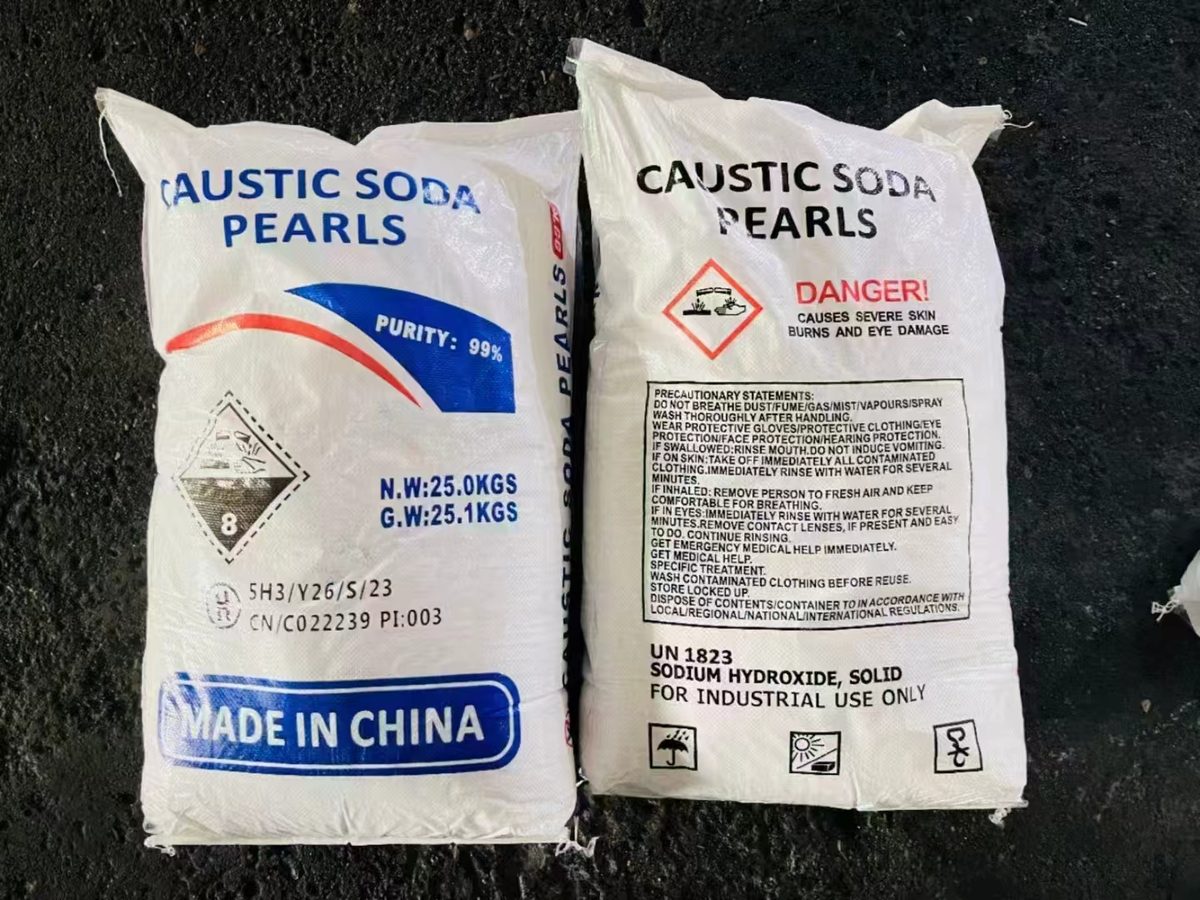
- Caustic soda prills / pearls — small spherical beads produced by prilling molten NaOH in a tower. Prills flow better and create less dust than flakes, which is why some buyers prefer them for automated dissolution systems
Common purity grades across all three forms include:
- Industrial / technical grade (99% min NaOH) — the workhorse grade for chemical synthesis, water treatment, soap, and most industrial applications
- Rayon grade — low iron and other heavy metals, used in viscose rayon fiber production
- Food-grade (FCC / E524) — used in cocoa processing, olive curing, fruit and vegetable peeling, and other food applications. Must meet heavy-metal limits and is shipped in food-grade packaging
- Pharmaceutical / analytical grade — high-purity reagent used in laboratories and pharma manufacturing
Standard specifications for industrial-grade caustic soda flakes:
| Parameter | Typical Specification |
|---|---|
| NaOH content | ≥99.0% |
| Na2CO3 | ≤0.5% |
| NaCl | ≤0.05% |
| Fe2O3 | ≤5 ppm |
| Appearance | White flakes or prills, free of visible contamination |
Key Industrial Applications
Caustic soda's largest end uses by volume:
- Alumina refining (Bayer process): Caustic soda is used to dissolve alumina from bauxite ore under high temperature and pressure. Alumina producers are typically the largest single consumers of NaOH in any country with an active aluminum industry
- Pulp and paper: Kraft pulp mills use NaOH and sodium sulfide (white liquor) to break down wood chips into cellulose fibers. Caustic soda is also used in paper recycling for de-inking
- Soap and detergent production: Sodium hydroxide saponifies fatty acids into sodium salts (soaps). It is also used to produce anionic surfactants like sodium lauryl sulfate (SLS) and sodium laureth sulfate (SLES)
- Textile processing: Mercerization of cotton (treatment with concentrated NaOH to increase strength, luster, and dye affinity); scouring of raw fibers to remove waxes and impurities
- Water and wastewater treatment: pH adjustment, removal of heavy metals (as hydroxide precipitates), regeneration of ion exchange resins, and neutralization of acidic wastewater streams
- Petroleum refining: Caustic scrubbing to remove acidic contaminants (H2S, mercaptans, CO2) from refinery gas and hydrocarbon streams
- Chemical synthesis: Production of sodium salts (sodium silicate, sodium formate, sodium acetate), organic intermediates, and many other downstream chemicals
- Food processing: Cocoa processing (Dutch processing to reduce bitterness and improve solubility), olive curing, fruit and vegetable peeling (lye peeling), and pretzel surface glazing
Safe Handling, Storage, and Transport
Caustic soda is strongly alkaline and corrosive. It reacts exothermically with water (releases significant heat), with acids (violent neutralization reaction), and with certain metals like aluminum and zinc (produces flammable hydrogen gas). Key points for buyers and warehouse teams:
- Personal protective equipment: Always use chemical-splash goggles, face shield, PVC or neoprene gloves, and a chemical-resistant apron when handling solid forms or working concentrations
- Storage: Keep dry, sealed, and away from acids, organics, and reactive metals. Solid forms absorb moisture and CO2 from air, slowly converting to sodium carbonate and reducing active NaOH content
- Dissolving solid NaOH: Always add caustic soda slowly to water, never water to caustic soda. The dissolution reaction releases substantial heat and can cause localized boiling if added too quickly
- Spill response: Contain spill, neutralize with dilute acetic acid or citric acid (not strong mineral acids), then flush with large amounts of water. Avoid skin contact — caustic burns penetrate deep and continue until fully neutralized
- UN classification: Caustic soda is UN 1823, Class 8 (corrosive). Solid forms in 25 kg bags require UN-certified packaging and a Dangerous Goods Declaration for sea or air freight
Sourcing Caustic Soda from China
China is the world's largest caustic soda producer, with chlor-alkali capacity supporting both the domestic alumina, pulp, and chemical industries and a large export market. For buyers sourcing from China, key considerations include:
- Producer qualification: Look for facilities on modern membrane-cell technology (energy efficient, high purity) rather than older diaphragm or mercury-cell processes. Membrane-cell NaOH typically has lower salt and heavy-metal content
- Form selection: Specify flakes vs. prills based on the receiving infrastructure. Prills flow better through automated dissolving systems; flakes dissolve faster in simple agitated tanks
- Packaging: The standard Chinese export format is 25 kg net woven polypropylene bags with inner polyethylene liner. Jumbo bags (500 kg or 1000 kg) are available for bulk orders. Liquid NaOH (50%) ships in ISO tanks for international buyers
- Inspection: Pre-shipment inspection (SGS, Bureau Veritas, or CCIC) is recommended for new suppliers. Verify NaOH content, sodium chloride, iron, and appearance against the agreed specification
- Documentation: Full export paperwork including COA (Certificate of Analysis), packing list, commercial invoice, certificate of origin, and Dangerous Goods Declaration (DGD)
VASTEC Chemical Supply of Caustic Soda
VASTEC Chemical supplies industrial-grade caustic soda (sodium hydroxide, NaOH, CAS 1310-73-2) in flakes and prills, sourced from established Chinese chlor-alkali producers. Our caustic soda supply program includes:
- Forms available: Caustic soda flakes 99% min NaOH, and caustic soda prills 99% min NaOH. Food-grade (FCC) available for food industry use
- Flexible volumes: From single-pallet trial orders (640 × 25 kg bags per 20ft container) to multi-container bulk contracts. Liquid 50% NaOH available in ISO tanks on request
- Packaging: 25 kg polypropylene bags with PE liner (standard), 500 kg and 1000 kg jumbo bags for bulk
- Quality verified: Every shipment ships with COA covering NaOH, Na2CO3, NaCl, and Fe2O3. SGS, Bureau Veritas, or CCIC pre-shipment inspection available on request
- Logistics: FOB Ningbo, Shanghai, or Qingdao with full export documentation including UN 1823 / Class 8 dangerous goods declaration
Caustic soda is a foundational industrial chemical, and reliable supply at consistent quality matters more than ever. Whether you are formulating detergents, treating effluent, or running an alumina refinery, the right Chinese supplier and a transparent quality verification process are the foundation of consistent operations. Contact VASTEC today for current product pricing, technical data sheets, and sample requests.